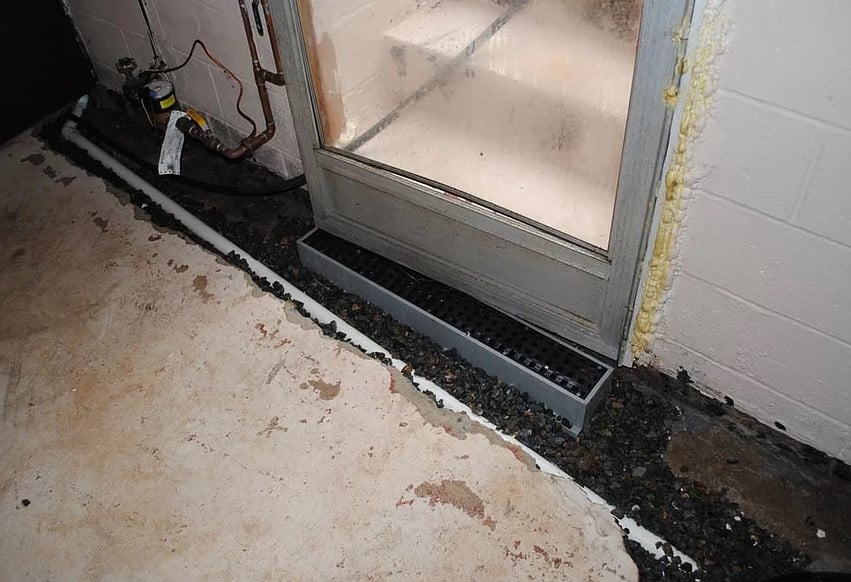
You wipe up a small puddle on your basement floor and assume someone spilled water or a pipe may be leaking. A few hours later, the puddle is back.
If the water keeps returning from the joint where the basement floor meets the wall, the problem usually isn’t inside your home—it’s underneath it.
As groundwater builds beneath your foundation, it creates pressure that forces water through tiny openings in the concrete. This process is called hydrostatic pressure, and it’s one of the most common causes of basement floor seepage throughout New York and Connecticut.
Quick Answer: An interior drain tile system is installed beneath the basement floor along the inside perimeter of your foundation. It captures groundwater before it reaches your basement, directs it through a perforated drainage pipe, and carries it safely to a sump pump that discharges the water away from your home.
Why Basement Floors Leak

Many homeowners believe basement leaks only happen when rainwater runs over the foundation or window wells.
In reality, water often enters from below.
After periods of heavy rain or snowmelt, the soil surrounding your home becomes saturated. This is especially common in parts of Westchester, Putnam, Dutchess, Fairfield, Hartford, and New Haven Counties, where clay-rich soils tend to hold water longer than sandy soils.
As the groundwater level rises, pressure builds beneath your basement floor. Since concrete naturally contains tiny pores and joints, water eventually finds the easiest path into your basement—usually through the cove joint where the wall meets the floor or through small cracks in the slab.
The leak you see inside is simply the visible symptom of groundwater pressure beneath your home.
Why Interior Drain Tile Systems Are Often the Better Solution
Many homeowners initially assume waterproofing must happen from the outside.
While exterior excavation is appropriate in some situations, it often requires digging around the entire foundation, removing landscaping, patios, decks, walkways, and other structures before waterproofing can even begin. This significantly increases both the project’s cost and disruption.
An interior drain tile system works differently.
Instead of trying to block water outside the foundation, it safely captures groundwater after it reaches the foundation but before it enters your living space. By relieving hydrostatic pressure beneath the basement floor, the system prevents water from building up where seepage occurs.
Rather than fighting groundwater, it gives the water a controlled path away from your home.
How an Interior Drain Tile System Works
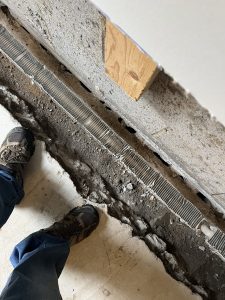
Installing an interior drainage system is a permanent structural improvement designed to protect your basement for decades.
The installation typically includes the following steps:
- A narrow section of concrete is carefully removed around the inside perimeter of the basement.
- A shallow trench is excavated alongside the foundation footing.
- Clean, washed drainage stone is placed in the trench to promote water flow and reduce sediment buildup.
- A perforated drain tile pipe wrapped with filter fabric is installed and sloped toward the sump basin.
- For concrete block foundations, small weep holes allow trapped water inside the wall to drain directly into the system instead of leaking onto the floor.
- The drainage pipe is covered with additional stone, protected with a vapor barrier, and sealed beneath new concrete that blends with the existing floor.
Once completed, the entire drainage system is hidden beneath the basement floor while continuously collecting groundwater before it becomes a problem.
Why a Reliable Sump Pump Matters
An interior drainage system is only as dependable as the sump pump that removes the collected water.
That’s why many homeowners in New York and Connecticut choose a primary sump pump paired with a battery backup system.
If severe weather causes a power outage during heavy rainfall, the backup pump automatically takes over, allowing the drainage system to continue protecting your basement until electricity is restored.
For homes located in areas that experience frequent storms or seasonal flooding, a backup sump pump provides an added layer of protection when it’s needed most.
Why Homeowners Across NY & CT Trust Sundahl Waterproofing
- Local basement waterproofing specialists serving New York and Connecticut
- Interior drain tile system installations engineered for regional soil conditions
- Honest inspections with no-pressure recommendations
- Professional sump pump and drainage solutions
- Serving homeowners throughout Westchester, Putnam, Dutchess, Fairfield, Hartford, and New Haven Counties
Protect Your Basement Before the Next Heavy Rain
Recurring basement seepage rarely disappears on its own. If water is entering where the basement floor meets the foundation wall, the problem is usually hydrostatic pressure beneath the slab—not a leaking pipe or overflowing gutter.
At Sundahl Waterproofing, we install professionally engineered interior drain tile systems that provide long-term protection for homes throughout Westchester County, Putnam County, Dutchess County, Fairfield County, Hartford County, and New Haven County. Every solution is tailored to your home’s foundation, groundwater conditions, and drainage needs.
Our team believes in honest recommendations, transparent pricing, and no high-pressure sales tactics. If an interior drainage system is the right solution, we’ll explain exactly why. If it isn’t, we’ll tell you that too.
Request your professional basement inspection from our Danbury or Larchmont office today and take the first step toward a permanently dry basement.
Please note: We do not currently service Bronxville, Mount Vernon, Yonkers, Rockland County, or New York City’s five boroughs.
Frequently Asked Questions About Interior Drain Tile Systems in NY & CT
Does an interior drain tile system permanently stop basement floor seepage?
Yes. A professionally installed interior drain tile system captures groundwater beneath the concrete slab before it reaches your basement floor. Instead of allowing hydrostatic pressure to force water through cracks or the floor-wall joint, the system redirects it into a sump pump where it is safely discharged away from the foundation.
Is an interior drain tile system better than waterproofing paint?
In almost every case, yes.
Waterproof coatings only attempt to block moisture after it reaches the basement wall or floor. An interior drainage system manages the water underneath the slab, relieving hydrostatic pressure before seepage occurs. This makes it a far more reliable long-term solution for homes throughout New York and Connecticut.
Does installing an interior drain tile system reduce my home’s resale value?
No. In many cases, it can increase buyer confidence.
Professional home inspectors and real estate professionals recognize engineered basement drainage systems as valuable structural improvements because they help protect the home from future moisture intrusion and foundation-related water damage.
Will an interior drainage system eliminate basement odors?
It significantly improves the conditions that cause musty smells.
By removing groundwater beneath the slab and lowering basement humidity, the system creates a much drier environment. While existing mold should be professionally remediated, controlling moisture addresses the underlying cause that allows mold and mildew to thrive.
How long does an interior drain tile system last?
High-quality interior drain tile systems are designed to last for decades.
Because the perforated PVC piping is installed below the concrete floor and surrounded by clean washed stone, it is protected from UV exposure, accidental damage, and normal wear. With routine sump pump maintenance, the drainage system itself typically provides lifetime protection.
Can this system be installed in finished basements?
Yes.
Professional installers carefully remove only a narrow section of concrete around the basement perimeter before installing the drainage system. Once complete, fresh concrete is poured flush with the existing floor, allowing the basement to be refinished with minimal impact.
Do homes in Westchester County and Fairfield County need interior drain tile systems?
Many do.
Homes throughout Westchester County, Putnam County, Dutchess County, Fairfield County, New Haven County, and Hartford County frequently experience hydrostatic pressure due to seasonal rainfall, snowmelt, and heavy clay soils. An engineered interior drainage system is one of the most effective long-term waterproofing solutions for these conditions.
What is the difference between a French drain and an interior drain tile system?
Although many homeowners use the terms interchangeably, they serve different purposes.
An exterior French drain diverts surface and groundwater before it reaches the foundation, while an interior drain tile system captures water after it reaches the foundation but before it enters the living space. Interior systems are often the preferred solution when exterior excavation is impractical or unnecessarily expensive.