

Every homeowner knows the uneasy feeling of spotting a fresh crack in a basement wall. Your mind instantly jumps to structural failure, dropping property values, and expensive repair bills. To cope with the anxiety, many people try to convince themselves that the house is “just settling” and that a quick coat of waterproof paint or a bead of hardware-store caulk will solve the problem. But ignoring a crack can be a dangerous gamble, depending entirely on its direction.
Featured Snippet Quick Summary: No, it is never safe to ignore a horizontal foundation crack. While fine vertical cracks often stem from normal concrete shrinkage, a horizontal crack across the middle third of a basement wall is a structural emergency. It indicates that external soil pressure is actively forcing the wall inward, leading to wall bowing, structural shearing, and eventual foundation collapse if left unaddressed.
The Physics Behind Bowing Foundation Walls

To understand why horizontal cracks are so dangerous, you have to look at the unique soil mechanics surrounding residential foundations in New York and Connecticut suburbs. Unlike the sandier soils found closer to the coastline, inland regions across Westchester, Putnam, Fairfield, and New Haven counties are packed with dense, heavy clay layers.
When heavy seasonal rain or melting snow saturates this clay, the dirt expands dramatically. This expansion creates an immense sideways force known as lateral hydrostatic pressure. Your underground basement walls act like a retaining wall or a ship’s hull, holding back thousands of pounds of waterlogged earth.
This pressure is compounded during freezing Tri-State winters by an action called frost wedging. When moisture-saturated soil freezes near the surface, it expands outward and downward like a giant mechanical wedge, driving straight into the upper section of your foundation. Caught between the immovable concrete floor at the bottom and the heavy weight of the house at the top, the middle third of the wall buckles under the stress, snapping horizontally.
The Stages of Progressive Structural Failure
A horizontal crack is rarely a static issue; it represents an active, progressive structural failure. Once the concrete block or poured wall has broken along a horizontal plane, its structural load-bearing capacity drops significantly. The failure typically advances through three distinct structural phases:
- Phase 1: Inward Tilting. The wall begins to push inward along the horizontal crack line, breaking the straight vertical plane.
- Phase 2: Progressive Bowing. As the wall curves inward, the upper sections pull away from the home’s wood framing (the sill plate), redistributing the weight of the entire house unevenly.
- Phase 3: Shearing at the Footer. Under extreme load, the bottom course of concrete blocks can physically slide inward across the concrete footer, leading to an imminent interior wall collapse.
As the foundation warps, the structural distortion travels upward into the living spaces. Homeowners quickly begin noticing secondary structural damage on the upper levels, such as sticky interior doors, misaligned windows that jam in their frames, and cracked drywall in first-floor rooms.
High-Tensile Structural Fixes: Carbon Fiber Bracing
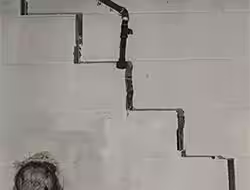
The good news is that catching a horizontal crack early—before the bowing exceeds two inches—allows for an engineered repair that completely avoids the need for heavy exterior excavation or wall demolition. Modern foundation stabilization relies on high-tensile carbon fiber strapping systems.{/ Reason: Procedural sequence outlining professional foundation repair engineering. Order is critical because proper surface preparation dictates chemical epoxy bond strength. /} Technicians utilize precision laser levels to calculate the exact inward curvature and deflection points of the bowing wall to map out optimal strap placement. The surface of the concrete or masonry blocks is ground down cleanly to remove all paints, coatings, and loose debris, exposing raw concrete for a perfect chemical bond. A high-strength structural epoxy resin is applied directly to the prepped concrete zones along the path of the stabilization straps. High-tensile carbon fiber straps—a material stronger than structural steel—are embedded into the epoxy, anchored securely to the heavy floor joists at the top and the solid footing at the bottom. A secondary layer of structural resin saturates the straps, locking the foundation wall permanently into its current position and preventing any future inward movement.
Frequently Asked Questions
Can you repair a bowing basement wall with waterproof paint or hydraulic cement?
No. Waterproof paint, hydraulic cement, and crack fillers only address surface moisture or minor cosmetic issues. They cannot resist the thousands of pounds of lateral soil pressure pushing against a foundation wall. If a wall is bowing or has a horizontal crack, it requires a structural repair solution such as carbon fiber reinforcement or another engineered stabilization system. Applying cosmetic products simply hides the symptoms while the structural damage continues to worsen.
Does homeowner’s insurance pay for horizontal foundation crack repairs?
In most cases, no. Standard homeowner’s insurance policies typically exclude foundation damage caused by hydrostatic pressure, expanding clay soil, frost heave, settling, or other forms of earth movement. Coverage may only apply if the damage results from a sudden covered event, such as certain plumbing failures. Because every policy is different, homeowners should review their coverage with their insurance provider. Detecting and repairing structural problems early is usually far less expensive than waiting until major reconstruction becomes necessary.
Will a wet basement make a horizontal foundation crack worse?
Yes. Excess moisture increases hydrostatic pressure around the foundation, allowing saturated soil to push harder against basement walls. Over time, water can also weaken mortar joints, contribute to concrete deterioration, and accelerate corrosion of reinforcing steel in poured concrete foundations. Combining structural stabilization with a professionally designed drainage or waterproofing system helps reduce future pressure and protects the repaired wall from continued movement.
How serious is a horizontal foundation crack?
A horizontal foundation crack is considered one of the most serious types of foundation damage. Unlike many vertical cracks that may result from normal concrete shrinkage, a horizontal crack often indicates that the basement wall is bending inward under excessive soil pressure. Without professional stabilization, the wall may continue to bow, shear, or eventually fail structurally.
When should I call a foundation repair specialist?
You should schedule a professional inspection as soon as you notice a horizontal crack, inward wall movement, stair-step cracking in masonry, or basement walls that appear to lean. Early intervention often allows less invasive repairs—such as carbon fiber reinforcement—before extensive wall reconstruction or replacement becomes necessary.
Don’t Let Structural Pressure Threaten Your Investment: Horizontal cracks and bowing basement walls never fix themselves—they only worsen with every seasonal rain and freeze cycle. Protect your home’s long-term safety with Sundahl Waterproofing’s advanced foundation repair solutions. True to our “No-Hassle” promise, we provide direct, honest structural evaluations without high-pressure sales scripts or artificial scare tactics. We proudly protect homes across Dutchess, Fairfield, Hartford, New Haven, Putnam, and Westchester Counties. (Please note: We do not service Bronxville, Mount Vernon, Yonkers, Rockland County, or the Five Boroughs. Contact our Larchmont, NY, or Danbury, CT, office today to secure your expert foundation assessment.